
Behind the Scenes at Compton Place

Updated: Sep 6

In 2016 I was fortunate enough to get a peek behind the scenes at Compton Place in Eastbourne, the former holiday home of the Duke of Devonshire, and not open to the public as it is now leased to a language school. Thanks to the Sussex Archaelogical Society, I was able to participate in a rare tour of the house and grounds. This picture above is not one I took that day – I seem to have lost my exterior shot – so this is from a creative commons licence – I don't recall there being tennis courts there on my visit. All the other images are my own.
The first room we visited was the former dining room, now a classroom. This was a superb example of the work of Colen Campbell the eighteenth century architect – who never visited the place he had designed in 1726.

Another stunning room was the Library which has beautiful original leather wallpaper. The room is marred by the presence of hideous 1960s strip lighting – which as it was there at the time of the houses' Grade I listing so cannot be removed without permission of English Heritage and Eastbourne Borough Council (the latter is apparently the greater challenge) and would require significant cost.

The only surviving image of the architect, Colen Campbell, anywhere in the world is here in the Gallery in a ceiling panel. The presence of the compass, dividers and hammer is possibly to signify his architect role –or possibly a masonic connection.

One of the most spectacular rooms in the house is the Duke's bedroom. This was built by William Cavendish, the then duke in expectation of a visit by King George II – which didn't happen due to the demise of poor old William soon after becoming Prime Minister at age 44.
The room has had its share of royal visitors though. George VI stayed in it while convalescing in Eastbourne for two weeks and the princesses Elizabeth and Margaret came to visit him here and later stayed in the house themselves for a fortnight in 1946.
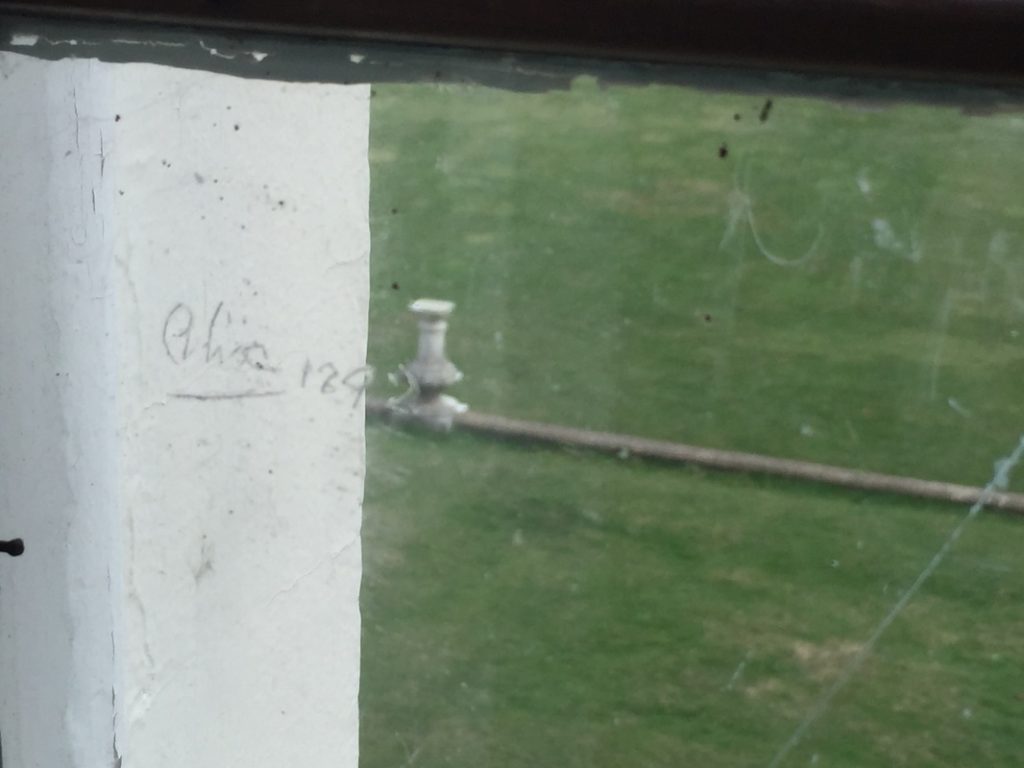
Queen Victoria's granddaughter, Alexandra of Hess, who later became the last Tsarina of Russia, left her mark in 1892 by carving her name and the date on the bedroom window pane with her diamond ring (something she apparently also did in St Petersburg, Moscow and tragically at Ekateringburg. You can see the evidence in the picture. (Alix 1892)
The house has an enormous kitchen, complete with dumb-waiter and two vast ovens. It is thought that this may also have originally been used by a local baker serving the Bourne village as the capacity is too large for the size of the house. There is a brewhouse too – where they will have brewed small beer.
In a walled garden we came across this bothy, built as a playhouse for the Devonshire children and currently housing bits and pieces of listed "stuff" that has to be preserved.

What was once a statue-lined walk has now lost its statues – removed to Chatsworth for health and safety reasons to avoid them toppling and crushing the pupils playing in the grounds of the school. As we went around the house, it was apparent that a lot of things had been relocated to Chatsworth: other than copies or items of no significant value, most of the paintings have gone. The cyclamen were blooming in a wooded glade behind the house.

The house became a language school in the 1950s. Its pupils included the late Prime Minister of Pakistan, Benazir Bhutto. The reason the Devonshires gave it up as their holiday home was the death of the tenth Duke and the resultant punitive death duties, which forced the sale of land and the leasing of the house and grounds.

There is a fascinating side note about the 10th duke's death. He and his son had been felling a tree in the grounds when he felt unwell. The local doctor was called, and three hours later the duke was dead. The doctor was Eastbourne's notorious alleged (but acquitted) serial killer of 163 patients, the precursor to Dr Shipman – Dr John Bodkin Adams, whose preference was usually for elderly wealthy widows, but had an apparent motive for killing the duke as he was a member of the Plymouth Brethren and had a loathing of freemasons, of which the duke was one. Harold MacMillan put the blocks on investigations into the circumstances of the duke's death, supposedly out of fear that the press might dig up dirt about his wife Dorothy's affair with Lord Boothby – Dorothy being the sister of the 10th duke. Perhaps the duke just had a heart attack – but we all like a good story!

Comments